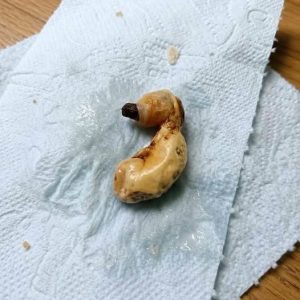
At first, I was convinced I had found something alive under my bed. A pale, curved object resting on the dusty floor looked strangely organic, with a dark pointed tip that immediately sparked frightening thoughts. I wondered if it was a parasite, part of a dead animal, or something dangerous hiding in the house. The longer I stared, the worse my imagination became.
I called my son over, hoping he would quickly explain what it was. Instead, he stopped and whispered, **“What is that?”** His uncertainty only made me more anxious. Neither of us wanted to get close, so we stood back, examining it from a distance while imagining every possible explanation. I even started thinking about strange noises, odd smells, and whether something had been hiding beneath the furniture for days.
After several minutes of guessing, I finally picked up a broom and carefully pushed the object into the light. The answer was almost impossible to believe. **“It wasn’t alive. It wasn’t a parasite. It wasn’t dangerous at all.”** It was simply half of a pistachio shell, covered in dust and darkened by old seasoning. It had probably rolled under the bed weeks earlier, but in the dim light it looked far more frightening than it really was.
For a moment, we just stared at it. Then we both burst into laughter, relieved that our fears had been completely unfounded. What had seemed like a household emergency turned out to be nothing more than a forgotten snack. The experience showed how easily fear can grow when we don’t have all the facts. Our minds often expect the worst before we take the time to confirm what we’re actually seeing.
The dusty pistachio shell became unforgettable, not because it was dangerous, but because it proved how powerful imagination can be. In just a few moments, an ordinary piece of trash became something terrifying simply because it was viewed from the wrong angle and without enough light. Even now, I still check under the bed a little more carefully—but I also remind myself that appearances can be deceiving.